Table of Contents
The Question I Hear Most in My Work
"Michael, should I stick with gas or switch to electric?" That's the first question out of a homeowner's mouth the moment they start thinking about replacing their heating system. I've heard it hundreds of times over the past 12 years from Texas to Ontario, from California homes to Alberta farmhouses.
The honest answer is: it depends. Dramatically. On your climate, your current equipment, your utility rates, and whether you plan to stay in the home long enough to earn back any upfront investment. The U.S. Department of Energy estimates that heating accounts for 40-60% of annual energy costs in cold climates, so picking wrong costs you real money every winter.
What I want to do in this guide is walk you through the actual math. Not generic advice, but the numbers specific to your situation. By the end, you'll know exactly which heating type makes sense for your home, your budget, and your climate.
How Gas and Electric Actually Compare
Let me start with the raw energy economics, because that's where most heating decisions actually get made.
Natural Gas: The Established Player
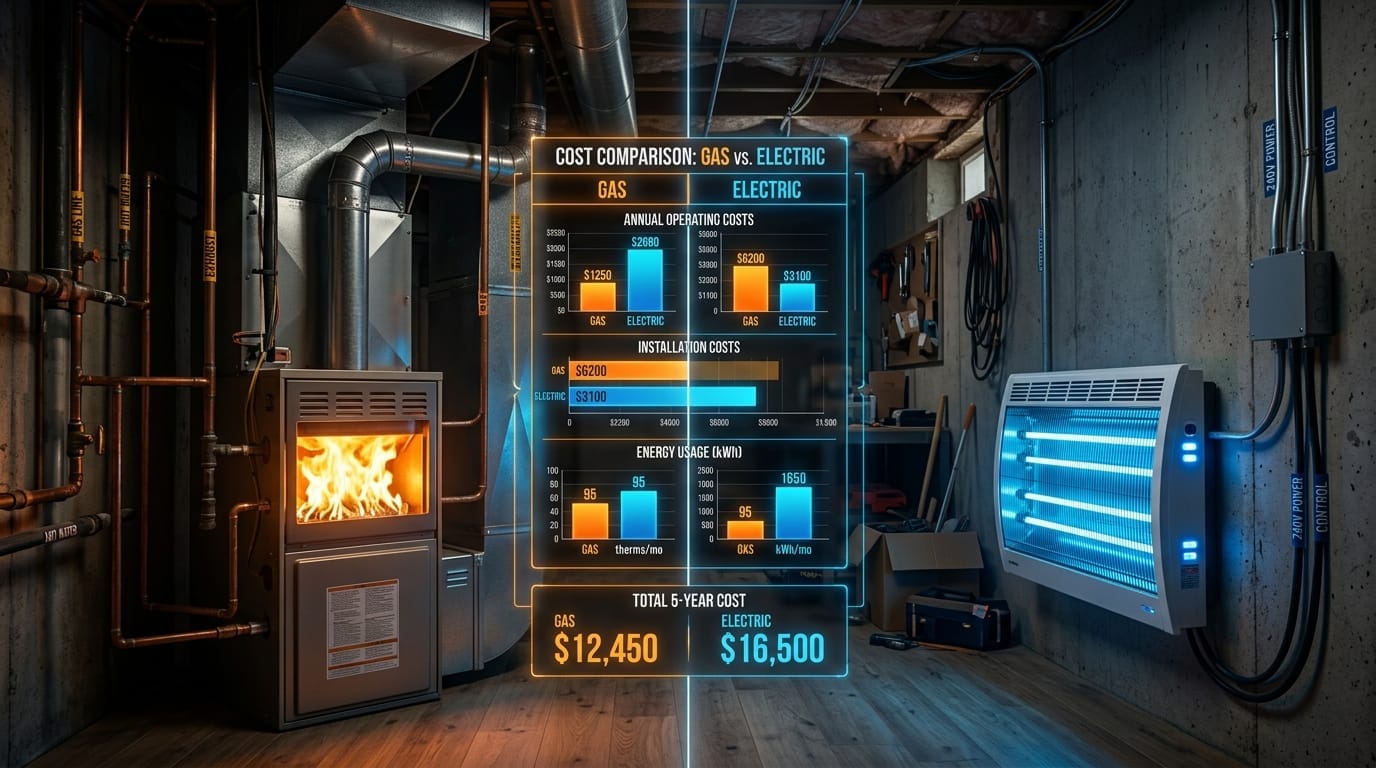
About 48% of American homes heat with natural gas, making it the dominant residential heating fuel. Current prices range from $0.80 to $1.50 per therm across different regions, with the national average sitting around $1.10/therm in 2025.
A therm equals 100,000 BTU of heat energy. For a 2,000 sq ft home in a cold climate (Zone 5-6), you're looking at 600-900 therms annually for heating. That puts annual gas heating costs at $660-$1,350 before efficiency losses.
Here's the catch: your furnace efficiency matters enormously. An older 80% AFUE (Annual Fuel Utilization Efficiency) furnace wastes 20% of every dollar you spend on gas. That $1,200 annual heating bill? You're actually getting $960 worth of heat. The other $240 goes up the flue. ENERGY STAR certified furnaces start at 95% AFUE, meaning significantly more heat per dollar.
Electric Heat: The Simple Alternative
Electric resistance heating (think baseboard heaters or electric furnaces) converts nearly 100% of electricity into heat—there's no flue, no combustion, no efficiency rating to worry about. Every kWh produces about 3,412 BTU of heat, consistently.
The problem is electricity prices. At $0.12-$0.18/kWh across most of the USA, electric resistance heating gets expensive fast. A 2,000 sq ft home in a cold climate might need 8,000-12,000 kWh annually for heating. At $0.15/kWh, that's $1,200-$1,800 per year—often 50-100% more than gas for equivalent warmth.
But here's where it gets interesting: heat pumps change the equation entirely.
The Heat Pump Advantage Changes Everything
A heat pump doesn't create heat—it moves it. Using the same refrigeration cycle that your AC uses (just reversed), a heat pump can deliver 250-400% efficiency. For every dollar of electricity, you get $2.50-$4.00 worth of heating.
In my experience analyzing heating costs across different systems, this efficiency advantage flips the economics in many regions:
| System Type | Typical Efficiency | Annual Heating Cost (2,000 sq ft home, Zone 5) | Estimated Annual Cost |
|---|---|---|---|
| Gas Furnace (80% AFUE) | 80% | 750 therms × $1.10/therm | $825 |
| Gas Furnace (95% AFUE) | 95% | 632 therms × $1.10/therm | $695 |
| Electric Resistance | 100% | 10,000 kWh × $0.14/kWh | $1,400 |
| Heat Pump (HSPF 10) | 350% | 2,857 kWh × $0.14/kWh | $400 |
| Cold-Climate Heat Pump | 400%+ | 2,500 kWh × $0.14/kWh | $350 |
*Costs are estimates based on average utility rates and assume moderate heating season of 5-6 months in Zone 5 (Mid-Atlantic/Ohio Valley)
Notice the heat pump column: at $350-$400/year, it beats gas even at current low gas prices. That's the efficiency advantage in action.
Pro Tip: If you're considering a new heating system and your utility offers heat pump rebates, factor those in. Many utilities across the USA and Canada offer $500-$2,500 rebates for heat pump installations, which can shorten payback significantly. The federal tax credit in the USA covers 30% of installation costs up to $2,000 through 2032.
Where Gas Still Wins (And Why)
I want to be honest: there are situations where gas makes more sense than any electric option. Here they are:
Coldest Climates (Very Cold Regions)
Standard air-source heat pumps struggle when temperatures drop below 25°F (-4°C). Below that point, they defrost frequently, lose efficiency, and may need backup resistance heat—which kills the economics.
In Minneapolis, where January averages 12°F, a client of mine switched to a cold-climate heat pump rated to -15°F. Her first winter heating cost was $780 versus $1,100 with her old gas furnace—but she had to install backup electric resistance strips for the coldest weeks, adding $180 to the total. The net savings were modest, and she had to deal with the noise and complexity of a dual-fuel setup.
If you live where temperatures regularly hit -10°F or colder for weeks, a high-efficiency gas furnace may simply be more practical and cost-effective than a cold-climate heat pump.
Where Electricity Is Expensive
Some regions have unusually high electricity rates. Hawaii tops the nation at $0.34/kWh average—gas is dramatically cheaper there. Parts of California, New York, and Alaska also have rates that make electric resistance heating economically unfeasible.
Even with heat pump efficiency, there's a breaking point. At $0.30/kWh, a heat pump's operational costs approach gas furnace levels, and the upfront premium for the heat pump may never pay back.
Existing Gas Infrastructure
If you already have gas lines, a gas furnace, and gas water heating, switching to all-electric means new equipment, potentially upgraded electrical service, and possibly new wiring. The conversion cost can be $5,000-$15,000 depending on your home's electrical capacity.
In that situation, staying with gas when your furnace needs replacement makes financial sense. Replace like-for-like: 80% furnace goes to 95%, and you bank the efficiency gains without the conversion cost.
What Works Where: A Region-by-Region Look
After years of working with clients across North America, here's what I've learned about which heating type wins in different parts of the continent:
Texas & Southwest (Arizona, New Mexico, Nevada)
Heat pumps win, hands down. Winters are short and mild—most of Texas only needs 2-3 months of heating. Electricity rates are moderate ($0.11-$0.14/kWh), and heat pump efficiency makes the math work beautifully. My clients in Austin, Phoenix, and Las Vegas who switched to heat pumps report $350-$500 annual heating costs versus $600-$800 with gas.
California (Coastal & Central)
PG&E rates are high ($0.25-$0.30/kWh for many residential customers), which complicates the heat pump equation. However, new time-of-use plans can make heat pumps economical by letting them run during off-peak hours. Many California clients are switching because of air quality regulations that restrict gas furnaces in new construction.
Pacific Northwest (Washington, Oregon)
Interesting case: Seattle has abundant hydroelectric power, creating low electricity rates ($0.10/kWh average). Combined with relatively mild winters, heat pumps make excellent sense here. Portland and Seattle utilities actively promote heat pumps with generous rebates. Heating costs of $300-$500/year are typical with heat pumps versus $800-$1,200 with gas.
Upper Midwest (Minnesota, Wisconsin, Michigan, North Dakota)
This is gas country, and for good reason. Long, cold winters (5-7 months) and cold-climate heat pumps that cost significantly more than standard units make gas the practical choice for most homeowners. If you're set on a heat pump here, budget for a cold-climate model ($8,000-$15,000 installed) and accept some efficiency loss during the coldest weeks.
Ontario & Quebec (Canada)
Electricity runs 20-30% more expensive than equivalent US rates ($0.12-$0.17/kWh), but natural gas prices are also higher in many provinces due to limited infrastructure. The math is closer than in the USA. Many Ontario homes use natural gas where available; electric heat pumps make sense for newer, well-insulated homes with access to time-of-use pricing that favors overnight heating.
Natural Resources Canada data shows heat pump adoption is accelerating across Canada, with federal and provincial rebates making the economics more attractive even in colder climates.
What I've Seen in Hundreds of Homes
Let me give you two real case studies from my 2024-2025 work that illustrate how different situations call for different solutions.
Case Study 1: Dallas Homeowner (Mild Winter)
A client in Dallas had a 20-year-old 80% AFUE gas furnace that needed replacement. Her 1,800 sq ft home uses maybe 400 therms annually for heating—Dallas winters are short and mild.
Gas replacement option: 95% AFUE furnace, installed cost $3,200. Annual heating cost: 380 therms × $1.15/therm = $437. Calculate your heating costs with our tool.
Heat pump option: SEER 16 heat pump, installed cost $6,500 (after rebates: $5,500). Annual heating cost: 2,200 kWh × $0.13/kWh = $286. Calculate heat pump costs for your home.
Annual savings: $151. Payback on the $3,200 upfront difference: 21 years—but factor in that the heat pump also provides cooling and has a longer expected life, and the math improves. I recommended the heat pump because it provides year-round value, not just heating.
Case Study 2: Minneapolis Homeowner (Harsh Winter)
Different story. A Minneapolis homeowner with a failing 85% AFUE furnace faced the same decision. Her 2,400 sq ft home uses 950 therms annually—long, cold winters.
Gas replacement: 95% AFUE furnace, installed cost $4,800. Annual heating: 870 therms × $1.10/therm = $957.
Heat pump: Cold-climate unit rated to -15°F, installed cost $14,200. Annual heating: 5,800 kWh × $0.11/kWh = $638—but she needed backup electric heat for 3 weeks when temps hit -10°F, adding $180. Total: $818.
Annual savings: $139. Payback on $9,400 difference: 67 years. I recommended the gas furnace. The numbers simply don't work for heat pumps in that climate unless you have strong environmental motivations or access to exceptional rebates.
For your own home, use our gas vs electric cost calculator to compare operating costs side by side based on your local rates.
How to Make Your Decision
If you're trying to decide between gas and electric heating, here's my practical framework:
- Know your climate: Heat pumps excel in mild-to-moderate winters (Zones 3-6). In Zone 7+ with extended sub-freezing periods, gas or cold-climate heat pumps are practical.
- Know your rates: Calculate your actual electricity cost per kWh and natural gas cost per therm. Divide your electricity rate by 3 to compare to gas on an equivalent heat-output basis.
- Know your home: A well-insulated, newer home makes heat pumps more attractive. An older, drafty home should address insulation and air sealing before investing in any heating system.
- Know your timeline: If you're staying in the home for 10+ years, the efficiency upgrade typically pays back. If you're moving in 3-5 years, stick with whatever's cheapest to replace.
What Most Homeowners Get Wrong: Comparing only the equipment cost, not the operating cost. I've seen homeowners pick a $3,000 gas furnace over a $7,000 heat pump because of upfront cost—then pay $600 more per year in heating bills for the next decade. The cheap option wasn't cheap.
Heating Fuel Questions Homeowners Ask
My neighbor swears by their heat pump, but we're in Minnesota—is that realistic?
It depends on your specific setup. Cold-climate heat pumps have come a long way and can work in much colder temperatures than people realize. But in areas where temperatures regularly drop below zero for weeks, gas furnaces often still make more financial sense. That said, some Minnesotans are making it work—especially those getting rebates from their utility company.
We have no gas line in our new neighborhood. What are our options?
That's becoming more common in newer developments. Your main choices are electric heat pump (most efficient), electric resistance (expensive but cheap to install), or extending the gas line (costly upfront but cheaper long-term if you stay put). Get quotes for all three before you build.
Is it true that Seattle is one of the few places where electric beats gas?
Kind of, but it's more nuanced than that. Seattle has unusually low electricity rates (hydroelectric power) and relatively high gas prices. This creates a rare situation where heat pumps can actually beat gas on operating costs. Other areas with cheap hydroelectric power, like parts of Quebec and Oregon, have similar dynamics.
We're on propane—should we switch to something else?
Propane is genuinely one of the most expensive heating fuels per unit of energy. If you're using propane, switching to almost anything else will likely save you money long-term. Natural gas if available is cheapest, then heat pump electric. The upfront costs can be significant, but the payback is usually 5-10 years.
How do I even know what rates I'm paying?
Check your latest utility bills. Look for the price per therm (gas) or per kilowatt-hour (electricity). Your gas rate should be on the bill somewhere, and many utilities now have online portals that show your rate history. If you can't find it, call your utility company's customer service line—they'll tell you.