Table of Contents
The $12,000 Question: Furnace or Heat Pump?
Last fall, a client in Minneapolis asked me the question I hear most: "Michael, I'm replacing my 22-year-old furnace. Everyone says heat pumps are the future, but I'm in Minnesota—is that realistic here?"
Her existing 85% AFUE gas furnace needed replacement. A new 95% AFUE furnace would cost $4,800 installed. A cold-climate heat pump would cost $12,500 installed (after rebates). The difference: $7,700 upfront.
But the operating costs told a different story. Her heating bills averaged $1,400/year with the old furnace. The new furnace would cost $1,190/year. The heat pump would cost $680/year in electricity—because even in Minnesota, heat pumps deliver 2-3x more heat per electricity dollar than electric resistance, and significantly more than a gas furnace in this efficiency comparison.
At $510/year savings, the heat pump would pay back the extra $7,700 in 15 years. That wasn't a great return—but add in the fact that the heat pump also provides AC (saving another $200-300/year in summer), and the picture changes. Calculate your potential AC savings. We were looking at 10-year payback, with the heat pump lasting as long as the furnace.
Let me walk you through exactly how to calculate this for your home, because the answer depends on your specific situation.
Upfront Cost Comparison
| System Type | Equipment Cost | Installation Cost | Total Installed | Expected Lifespan |
|---|---|---|---|---|
| Gas Furnace (80% AFUE) | $1,200-2,000 | $1,500-2,500 | $2,700-4,500 | 18-22 years |
| Gas Furnace (95% AFUE) | $2,000-3,500 | $1,500-3,000 | $3,500-6,500 | 18-22 years |
| Heat Pump (SEER 15) | $2,500-4,000 | $2,000-4,000 | $4,500-8,000 | 12-15 years |
| Heat Pump (SEER 20+) | $4,000-7,000 | $2,500-5,000 | $6,500-12,000 | 12-15 years |
| Cold-Climate Heat Pump | $5,000-9,000 | $3,000-5,000 | $8,000-14,000 | 12-15 years |
*Costs are national averages; add 20-40% in high-cost regions
Heat pumps cost 50-100% more than furnaces upfront. But remember: a heat pump replaces BOTH your furnace and AC. If you're replacing both anyway, the comparison changes—now you're comparing furnace + AC versus heat pump.
The U.S. Department of Energy states that heat pumps can reduce heating costs by 30-50% compared to electric resistance heating, and by 15-30% compared to fuel-based heating systems like propane or oil furnaces.
Operating Cost Comparison
Here's where heat pumps often win—or lose, depending on your situation. Let's compare annual operating costs for a 2,000 sq ft home in different climates:
| Climate | Gas Furnace (95%) | Cold-Climate Heat Pump | Annual Savings with HP |
|---|---|---|---|
| Hot-Humid (Houston, Tampa) | $400-600 (AC + minimal heat) | $350-550 | $50-100/year |
| Mixed (Atlanta, Dallas) | $800-1,000 | $450-600 | $350-400/year |
| Cold (Minneapolis, Denver) | $1,200-1,500 | $700-1,000 | $400-500/year |
| Very Cold (Montreal, Alberta) | $1,500-2,000 | $1,000-1,400 | $400-600/year |
*Heating fuel at 2025 prices: Gas $1.10/therm, Electricity $0.13/kWh average
Heat pumps save money in most climates because they deliver 2-4 units of heat for every unit of electricity. Even with higher electricity rates than gas, the efficiency advantage usually wins.
The exception is in extremely cold climates where the heat pump struggles to extract enough heat from cold air, requiring backup electric resistance heat—which kills the efficiency advantage.
How Climate Affects Your Decision
Hot Climates (Houston, Florida, Arizona):
Heat pumps are the clear winner. They provide both heating AND cooling with excellent efficiency. Payback on premium heat pumps is usually 8-12 years, often shorter when replacing both AC and furnace.
Mixed Climates (Mid-Atlantic, Southeast, Texas):
Heat pumps make sense for most homes. The heating season is moderate, and the cooling benefit is significant. Payback is typically 10-15 years for cold-climate units.
Cold Climates (Minnesota, Wisconsin, Northern New York):
More complicated. Standard heat pumps won't work well—need cold-climate units rated to -15°F or lower. The math is closer to gas furnaces. Consider dual-fuel systems (heat pump + gas furnace) for best of both worlds.
Very Cold Climates (Canada, Northern Montana, Alaska):
Gas furnace is usually the practical choice. Heat pumps can work but require expensive cold-climate models, and backup heat adds cost. Unless you have very high electricity rates or strong environmental motivations, gas wins.
Pro Tip: Check your utility's rebate programs. Many utilities offer $500-$2,000 rebates on heat pump installations, and the federal tax credit covers 30% of heat pump costs up to $2,000 through 2032. These incentives can cut 3-5 years off your payback.
The 15-Year Total Cost Analysis
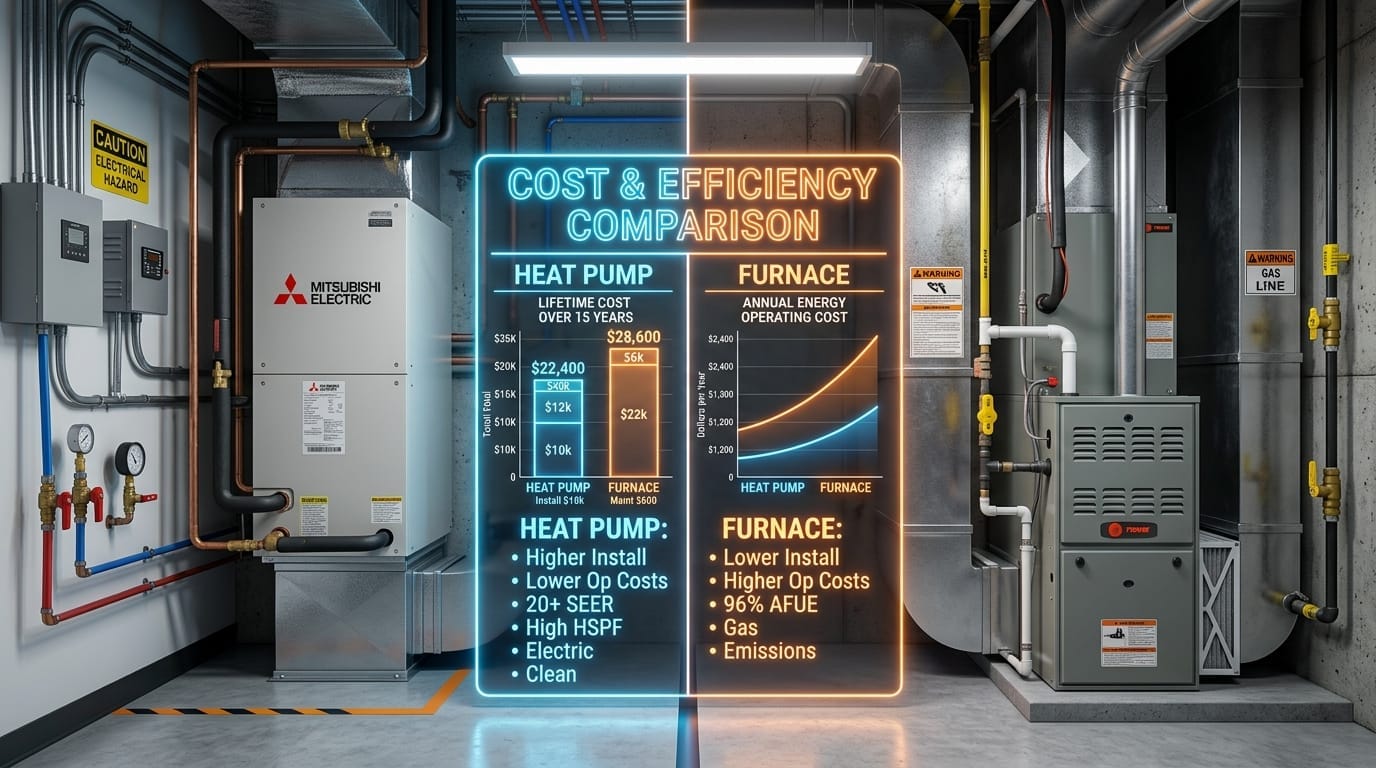
The real comparison isn't upfront versus operating—it's total cost over the equipment's life. Here's a 15-year analysis:
Scenario: Minneapolis home, replacing both AC and furnace
Option 1: 95% AFUE Furnace + SEER 16 AC
- Upfront: $5,500
- Operating (15 years at 3% annual increase): $18,000
- Maintenance: $2,250
- Total 15-year cost: $25,750
Option 2: Cold-Climate Heat Pump
- Upfront: $11,500 (after $2,000 rebate)
- Operating (15 years at 3% annual increase): $9,500
- Maintenance: $1,500
- Total 15-year cost: $22,500
Calculate heat pump costs for your specific situation. The heat pump saves $3,250 over 15 years in this scenario—and provides superior cooling, no gas connection needed, and better humidity control.
The Dual-Fuel Option You Might Consider
Here's an option that combines the best of both worlds: a dual-fuel system with a heat pump as primary heat and a gas furnace as backup.
The system switches to furnace when outdoor temperatures drop below a certain threshold (usually 25-35°F), where heat pump efficiency drops significantly. Above that threshold, the heat pump handles all heating at a fraction of the gas cost.
For cold climates, this can be the optimal solution:
- Heat pump handles heating 80-90% of hours (fall, early winter, spring)
- Furnace handles the coldest weeks only
- Get most heat pump savings while maintaining reliability in extreme cold
Cost is similar to a standalone heat pump (furnace installation adds but you already need the AC replacement).
Two Case Studies From My Work
Case Study 1: Dallas, Texas (Mixed Climate)
A client replaced a failing 20-year-old system. Gas furnace + AC cost: $5,800. Cold-climate heat pump: $9,200 (before rebate).
With the $1,500 utility rebate, the heat pump net cost was $7,700—only $1,900 more than the furnace/AC combo.
Operating savings: $350/year (heat) + $180/year (cooling) = $530/year. Payback: 3.6 years. The heat pump was clearly the better choice in this climate.
Case Study 2: Calgary, Alberta (Very Cold Climate)
A client in Calgary faced the same choice. Gas furnace + AC: $6,200. Cold-climate heat pump: $14,000.
The heat pump would save maybe $300/year in operating costs—46-year payback. Too long to justify.
We went with a 96% AFUE furnace. The math was clear: gas won in this climate, despite the environmental appeal of electric heat.
The Trap Most People Fall Into: Assuming heat pumps are always better for the environment. This depends on how your electricity is generated. In areas with coal-heavy grids, a high-efficiency gas furnace may actually have a lower carbon footprint than a heat pump. Check your local grid mix before making environmental decisions based on fuel type.
Factors That Should Sway Your Decision
Do you currently have natural gas?
If yes, gas is likely cheaper. If no (all-electric or propane), heat pumps offer massive savings over electric resistance.
How long will you stay in the home?
If less than 7 years, gas furnace usually wins—won't recoup heat pump premium. If more than 10 years, heat pump often makes sense.
What is your current AC like?
If AC also needs replacement, the heat pump comparison improves—now you're comparing furnace + AC vs. heat pump alone.
What are your utility's heat pump rebates?
Aggressive rebates can cut years off payback. Check before deciding.
What are your environmental priorities?
If carbon reduction is a priority and you have a clean grid (hydro, nuclear, solar), heat pump wins even in cases where gas is cheaper financially.
Heat Pump vs Furnace: Top Questions
Do heat pumps work in Minnesota winters?
Yes, but you need a cold-climate heat pump rated to -15°F or lower. These units cost more ($8,000-14,000 installed) but can extract heat from air as cold as -15°F. In extreme cold, they'll need backup heat (either electric resistance or a gas furnace in a dual-fuel setup). Many Minnesotans are successfully using heat pumps, but the payback is longer than in milder climates.
What about the noise? My neighbor says heat pumps are loud.
Modern heat pumps are much quieter than older models. The compressor and fan are typically outside, similar to a central AC. Inside, you only have blower air moving through ducts—quieter than a furnace. Placement matters; install away from bedrooms and neighbor property lines.
Is a heat pump more maintenance than a furnace?
Slightly more complex, but similar maintenance requirements. Annual professional service is still recommended. The main difference: you'll need to defrost the outdoor coil periodically in humid/cold conditions (automatically handled by the system). Overall, maintenance cost and effort are comparable to a furnace + AC combination.
What about Colorado? It's cold at altitude but sunny.
Colorado's high altitude and cold winters make this a genuinely close call. Natural gas is relatively cheap there, which favors furnaces. But many new homes are going heat pump because of utility incentives and the desire for all-electric construction. I'd recommend getting quotes for both and running a 15-year total cost analysis before deciding.
Why do heat pump installations cost so much more than furnace replacements?
Heat pumps are more complex machines—they do the work of both a furnace and an air conditioner in one unit, with sophisticated controls to manage the refrigeration cycle in both directions. You're essentially paying for two pieces of equipment in one package, plus the electronics to make it all work together smoothly.