Table of Contents
The $540 Electric Bill That Told Me Something Was Wrong
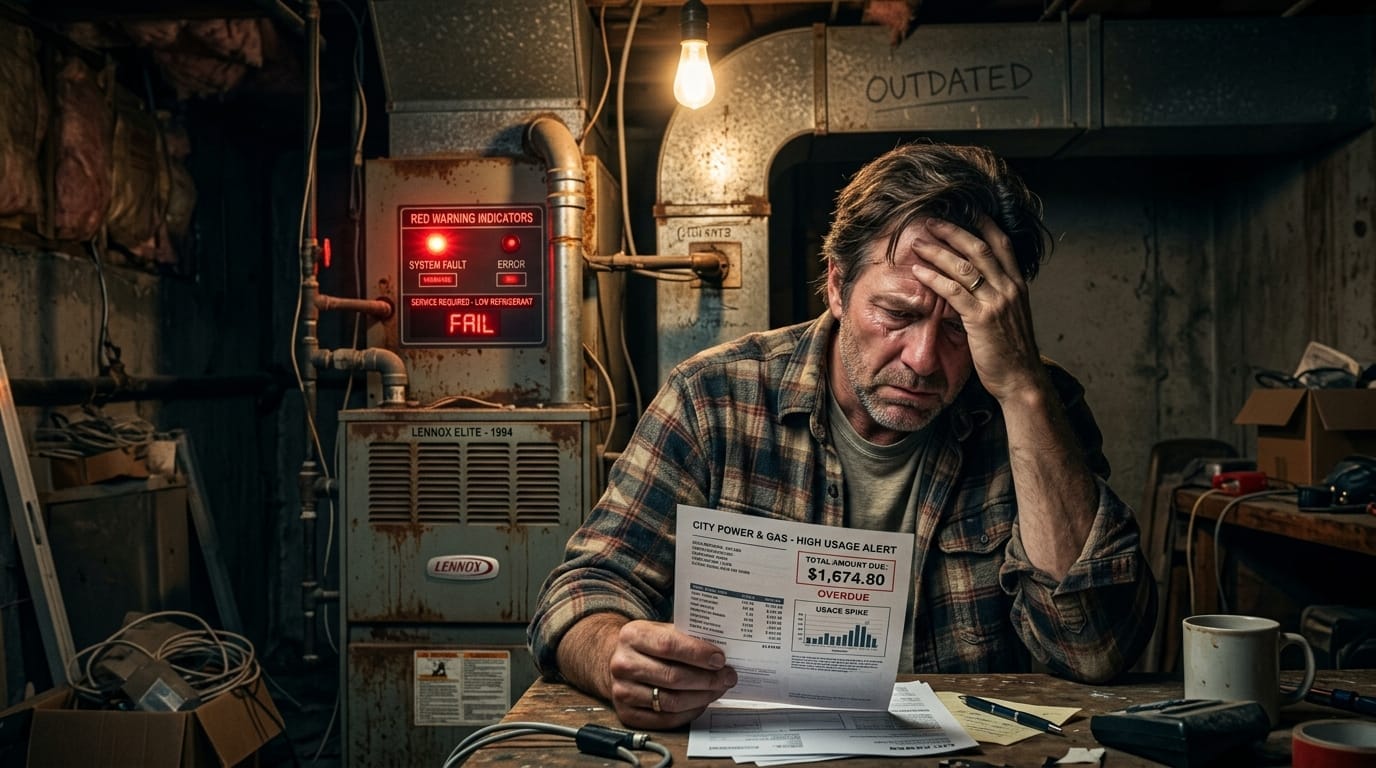
October 2024. I opened my electric bill—$540 for a 2,100 sq ft home in Ontario. The previous October had been $380. Same thermostat settings, same weather patterns, same family. Something was clearly wrong.
That bill sent me investigating. I measured my HVAC runtime, checked my furnace efficiency, inspected every component I could access. What I found: a 14-year-old furnace with a cracked heat exchanger, operating at 72% efficiency instead of its rated 80%. The other 8% wasn't just inefficiency—it was potential carbon monoxide leaking into my home.
That was the moment I realized: your HVAC system gives you warning signs before it becomes a major problem. You just have to know what to look for. In this guide, I'll walk you through the exact signs that your HVAC system is costing you more than it should—and what to do about each one.
Sign 1: Rising Energy Bills Without Explanation
The most obvious sign something is wrong: your bills go up while your behavior stays the same. But "rising" is relative—you need context.
Here's how to tell if rising bills indicate a problem: compare year-over-year same-month usage. June 2024 vs June 2023. Same cooling season, similar temperatures. If usage increased 15%+ with no behavioral changes, something has changed in your system.
Common causes I see:
- Equipment degradation: An aging AC loses 1-2% efficiency per year. A 15-year-old system may be 15-20% less efficient than when it was new.
- Ductwork deterioration: Duct connections loosen over time, increasing leakage. A system that was 90% efficient at delivering air might now be at 75%.
- Refrigerant leaks: Slow leaks cause your AC to work harder, using more electricity for less cooling.
- Filter neglect: A clogged filter forces your system to work against restricted airflow—energy usage can increase 5-15%.
Case study: A client in Houston noticed his July bill jumped from $165 to $220 year-over-year. Upon inspection, his AC had a slow refrigerant leak—topped off each year but never properly repaired. The system was working at 75% capacity while using nearly full power. After repair and proper charging, his bill dropped back to $165.
Sign 2: Unusual Runtime Patterns
Your HVAC system should run in steady cycles, not constantly. Here's what to watch for:
Short Cycling
If your AC turns on and off every 5-10 minutes, it's short cycling. This typically indicates:
- Oversized equipment (system too big for the home)
- Low refrigerant (compressor trips on high pressure)
- Dirty condenser coil (can't release heat properly)
- Electrical issues (capacitor failing, contactor problems)
Short cycling wastes energy because the system uses the most power during startup. The Department of Energy estimates short cycling can increase energy use by 20-30% while providing less dehumidification.
Constant Running
Conversely, if your system runs all day and never reaches temperature, that's also a problem:
- Undersized equipment (system too small for the load)
- Major refrigerant leak
- Failed compressor valve (compressor runs but doesn't compress)
- Severely clogged filter restricting all airflow
Constant running dramatically increases electricity consumption while often failing to achieve comfort.
Pro Tip: Modern smart thermostats track runtime hours. Check your thermostat's "equipment runtime" data—a properly sized AC should run 15-25 minutes per cycle on moderate days, 45-90 minutes on hot days. Anything outside this range warrants investigation.
Sign 3: Inconsistent Temperatures Throughout Home
If some rooms are comfortable while others are too hot or cold, your system is costing you money in two ways: you're not comfortable, and your HVAC is working harder to compensate.
Common causes of temperature imbalances:
- Ductwork leaks: Air leaks in ducts deliver less air to distant rooms
- Poor insulation: Some rooms gain/lose more heat than others
- Sun exposure: West-facing rooms absorb more heat in afternoon
- Return air problems: Closed vents, blocked returns, or poor return design
- Zoning issues: In multi-story homes, gravity affects airflow distribution
A quick test: place thermometers in multiple rooms at the same thermostat setting. If you find 5°F+ differences between rooms, you have a distribution problem that's costing you money.
Case study: A client in Dallas had a 2-story home where upstairs was always 5-7°F warmer than downstairs. The return was downstairs, creating a pressure imbalance that pushed cool air to the lower level. After adding a return and balancing the ductwork, the temperature difference dropped to 2°F and her energy bills decreased $35/month.
Sign 4: Unusual Sounds and Odors
Your HVAC system talks to you through sounds and smells. Here's what to listen for:
Sounds That Mean Trouble:
- Banging or booming: Usually indicates serious problems—possibly a cracked heat exchanger or failing blower assembly. This requires immediate professional inspection.
- Squealing: Often a failing blower motor bearing or slipping belt. Can often be repaired if caught early.
- Hissing: Usually a refrigerant leak. Can be expensive to repair but necessary for both efficiency and environmental reasons.
- Rattling: Loose components—often something as simple as a loose screw, but can become worse over time.
- Clicking (constant): Usually a failing contactor or relay. The system tries to start but can't.
Odors That Mean Trouble:
- Rotten egg smell: Could be a gas leak—very dangerous, leave home immediately and call gas company
- Musty: Mold in the ductwork or standing water in the drain pan—affects indoor air quality
- Burning electrical: Could be an electrical problem in the system—turn off and call professional
- Metallic: Often indicates motor bearing issues or metal-on-metal contact
The Trap Most People Fall Into: Ignoring unusual sounds because "it still works." By the time you hear audible problems, the issue has usually progressed significantly. Early intervention prevents expensive repairs and extends equipment life.
Sign 5: Visual Signs of Decline
Many problems are visible if you know what to look for:
| Sign | What It Means | Impact |
|---|---|---|
| Frost on indoor coil | Refrigerant issue, possible leak | Major efficiency loss |
| Water pooling around unit | Clogged drain, possible overflow | Water damage, mold |
| Visible rust/corrosion | System aging, moisture present | Potential failure |
| Dirty condenser (outside) | Restricted heat transfer | 10-30% efficiency loss |
| Discolored flame (gas) | Combustion problems | Safety hazard, inefficiency |
| Accumulated debris around unit | Restricted airflow | Reduced capacity |
Monthly visual inspections take just a few minutes but catch problems early. Walk around your system, look for anything unusual, and note changes from month to month.
Sign 6: Frequent Repairs
Track your repair history. If you're calling for service more than once per year, pay attention:
- 2 repairs in past 2 years: System is entering decline phase
- 3+ repairs in past 2 years: System is on borrowed time
- Any repair over $500 on system over 15 years: Consider replacement instead
The repair-versus-replace calculation: If your system is 15+ years old and you've spent more than $1,000 on repairs in the past 2 years, you're better off replacing. A new system comes with warranties, efficiency improvements, and reliability that repairs can't provide.
ENERGY STAR certified equipment comes with enhanced quality standards. The minimal additional cost over standard equipment is usually justified by improved reliability.
Sign 7: System Age and Original Efficiency
Know how old your system is and what efficiency it was when new:
AC Systems:
- Pre-2006: SEER 10 or lower (very inefficient by today's standards)
- 2006-2014: SEER 13-14 (federal minimum at that time)
- 2015-present: SEER 14 minimum, up to SEER 25+
- Every SEER point above 14 improves efficiency roughly 5-7%
Furnaces:
- Pre-1990: AFUE 60-70% (very inefficient)
- 1990-2005: AFUE 80% (standard efficiency)
- 2006-present: AFUE 90-98% (high efficiency)
A 25-year-old system, even if still running, is likely operating at 50-60% efficiency of a modern equivalent. The energy waste alone often justifies replacement.
What to Do If You See These Signs
Step 1: Schedule a professional inspection. A qualified HVAC technician can identify problems that aren't visible to homeowners. Expect to pay $100-200 for a thorough evaluation.
Step 2: Get a second opinion if repair is recommended. Not all contractors are honest—some recommend expensive repairs on systems that should be replaced.
Step 3: Compare repair cost to replacement cost. If repair exceeds 50% of replacement cost, seriously consider replacement—especially for systems over 15 years old.
Step 4: Consider efficiency upgrades. Replacement is the perfect time to improve efficiency—a SEER 16 to SEER 22 upgrade saves money every month going forward.
HVAC Warning Signs Questions
How often should I service my HVAC system?
At minimum, service your AC in spring and furnace in fall—typically $150-300 per visit. This catches small problems before they become expensive ones. Some systems can go longer between services if they're newer and performing well, but the annual cost of maintenance is far less than the cost of emergency repairs.
Is it worth repairing a 20-year-old system?
Usually no. At 20 years, systems are well past their expected lifespan. Even successful repairs often only extend life by 1-3 years, and you're still dealing with dramatically lower efficiency than modern equipment. The math rarely works in favor of repair for systems this old—replacement is almost always the better investment.
My system is making a noise but still works. Can I wait?
That depends on the noise. Banging, booming, or hissing sounds indicate serious problems that could become dangerous or cause major damage. Squealing or rattling might be less urgent but still need attention within weeks, not months. If you're unsure, err on the side of caution and have it checked. The cost of a service call is far less than the cost of a catastrophic failure.
My energy bills increased but the system seems to work fine. Should I be concerned?
Yes. Increasing bills without changes in behavior almost always indicate a problem—usually efficiency loss. A system can appear to work normally while using significantly more energy. Compare year-over-year same month bills, and if usage increased 15%+, schedule an inspection to find the cause.
How do I know if my system is the right size?
Properly sized systems run in cycles of 15-25 minutes on moderate days. If your system constantly runs (undersized) or cycles every 5-10 minutes (oversized), it's incorrectly sized. Short cycling is actually more common and more problematic—it wastes energy and causes comfort issues.