Table of Contents
Central AC vs Window Units: The Real Cost Comparison
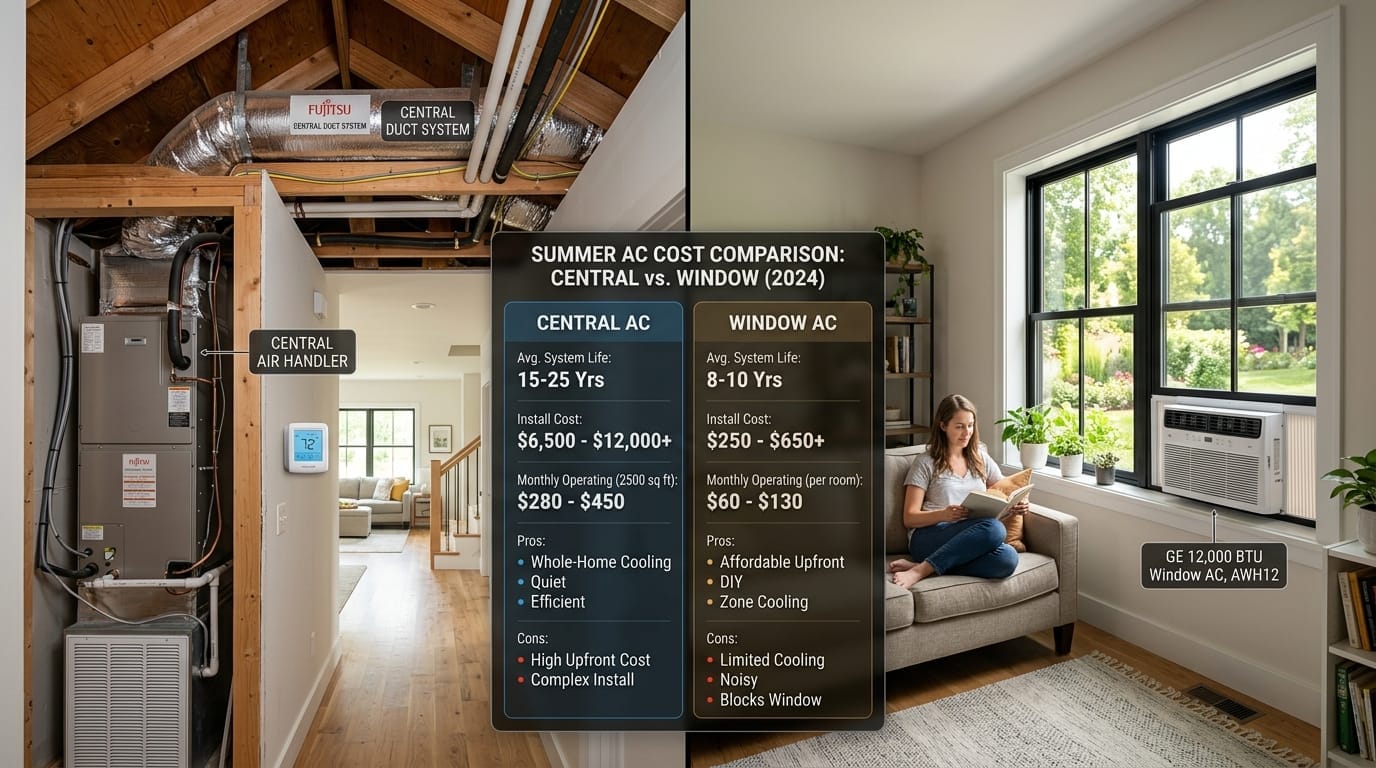
When my sister in Austin needed to replace her AC last year, she faced the classic choice: install central AC for $5,500 or buy three window units for $600. She chose window units. A year later, she's second-guessing that decision. Here's the detailed breakdown to help you make the right call.
Upfront Cost Comparison
| System Type | Cost Range | Lifespan | Typical Coverage |
|---|---|---|---|
| Window Unit (5,000-8,000 BTU) | $150-300 | 8-12 years | 1-2 rooms |
| Window Unit (10,000-12,000 BTU) | $250-450 | 8-12 years | 1 large room |
| Multiple Window Units (3) | $600-1,200 | 8-12 years | Whole house |
| Central AC (SEER 14) | $3,500-5,500 | 15-20 years | Whole house |
| Central AC (SEER 18+) | $5,000-8,000 | 15-20 years | Whole house |
| Mini-Split (per zone) | $2,000-4,000 | 15-20 years | 1-2 rooms |
Operating Cost Comparison
Here's the key difference: window units typically have lower SEER ratings (9-12) than central systems (14-25). This means higher operating costs for equivalent cooling:
| System | Monthly Cost (4 months) | Annual Cost | 10-Year Cost |
|---|---|---|---|
| Central AC (SEER 16) | $100-150 | $400-600 | $4,000-6,000 |
| Window Units (3×10,000 BTU) | $150-220 | $600-880 | $6,000-8,800 |
| Mini-Split (SEER 20) | $80-120 | $320-480 | $3,200-4,800 |
*For 2,000 sq ft home, 8 hrs/day, $0.14/kWh
ENERGY STAR certified central AC units are at least 15% more efficient than standard models—the savings add up significantly over the system's life.
When Central AC Makes More Sense
- Whole-house cooling: Central AC cools every room uniformly
- Higher efficiency: Lower operating costs over time
- Better dehumidification: Central systems remove more humidity
- Cleaner aesthetics: No window units blocking windows
- Higher home value: Central AC is expected in most US markets
- Better air filtration: Central systems connect to whole-house filters
Pro Tip: If you're considering central AC, time the replacement with your furnace. Replacing both at once is cheaper than two separate installations, and proper matching of equipment maximizes efficiency.
When Window Units Make More Sense
- Very limited budget: Window units are 80-90% cheaper upfront
- Rental property: Easy to remove when tenant changes
- Historical home: No ductwork and can't install mini-splits
- Single room needs: Only cooling one or two rooms
- Temporary situation: Planning to move in a few years
The Middle Ground: Ductless Mini-Splits
Mini-splits offer an alternative that splits the difference:
- Efficiency: SEER 20-25, similar to best central systems
- Cost: $2,000-5,000 per zone, much less than central ductwork
- Installation: Much simpler than central—requires only refrigerant lines and electrical
- Control: Each zone can be set to different temperature
For older homes without ductwork, mini-splits often make more sense than adding ductwork or using window units.
If you need help determining the right cooling capacity for your space, use our cooling load calculator to estimate the BTUs required for your home.
Decision Guide: Which Is Right For You?
| Situation | Best Choice | Why |
|---|---|---|
| Own home, plan to stay 5+ years | Central AC | Better ROI, lower operating costs |
| Very tight budget, renting | Window Units | Lowest upfront cost, portable |
| Old home, no ductwork | Mini-Split | Efficient, no ductwork needed |
| Multiple zones, different preferences | Mini-Split | Individual room control |
| Just one room to cool | Window/Mini-Split | Central overkill |
Central AC vs Window Unit Questions
Can I add central AC to a house without existing ducts?
You can, but it costs extra. Adding ductwork to a house without it runs $8,000-15,000 depending on layout. If that's too much, consider a ductless mini-split system—they cost $2,000-5,000 per zone and don't require any ductwork. The tradeoff is wall-mounted indoor units instead of ceiling vents.
Why do window units make that weird gurgling sound?
That's refrigerant flowing through the system—totally normal. The concerning sounds are grinding (motor bearings dying), rattling (loose parts), or hissing (refrigerant leak). If your unit suddenly sounds different, check it before the summer heat forces it to work harder. A $100 repair now beats a $500 replacement in August.
Which is more efficient: multiple window units or one central AC?
Central AC is typically more efficient because it runs at higher SEER ratings. Window units typically max out at SEER 12, while central systems start at SEER 14 and go up to SEER 25. However, if you're only cooling one room, running a window unit is more efficient than running your whole central system for that one room.