Table of Contents
Every few months, a client asks me the same question with the same frustrated tone: "Should I just go with the most efficient system?" They usually follow it up with something like, "The contractor said it'll pay for itself, but it's $4,000 more."
After analyzing HVAC efficiency decisions for over a thousand homes across North America, I've developed a clear answer: it depends. Sometimes the premium efficiency makes perfect sense. Sometimes it's the worst financial decision you can make. The difference isn't the equipment—it's your climate, how long you stay, what you're replacing, and your local energy costs.
Let me show you exactly when each scenario applies so you can make this decision based on actual numbers rather than sales pitches.
When Premium Efficiency Is a Waste of Money
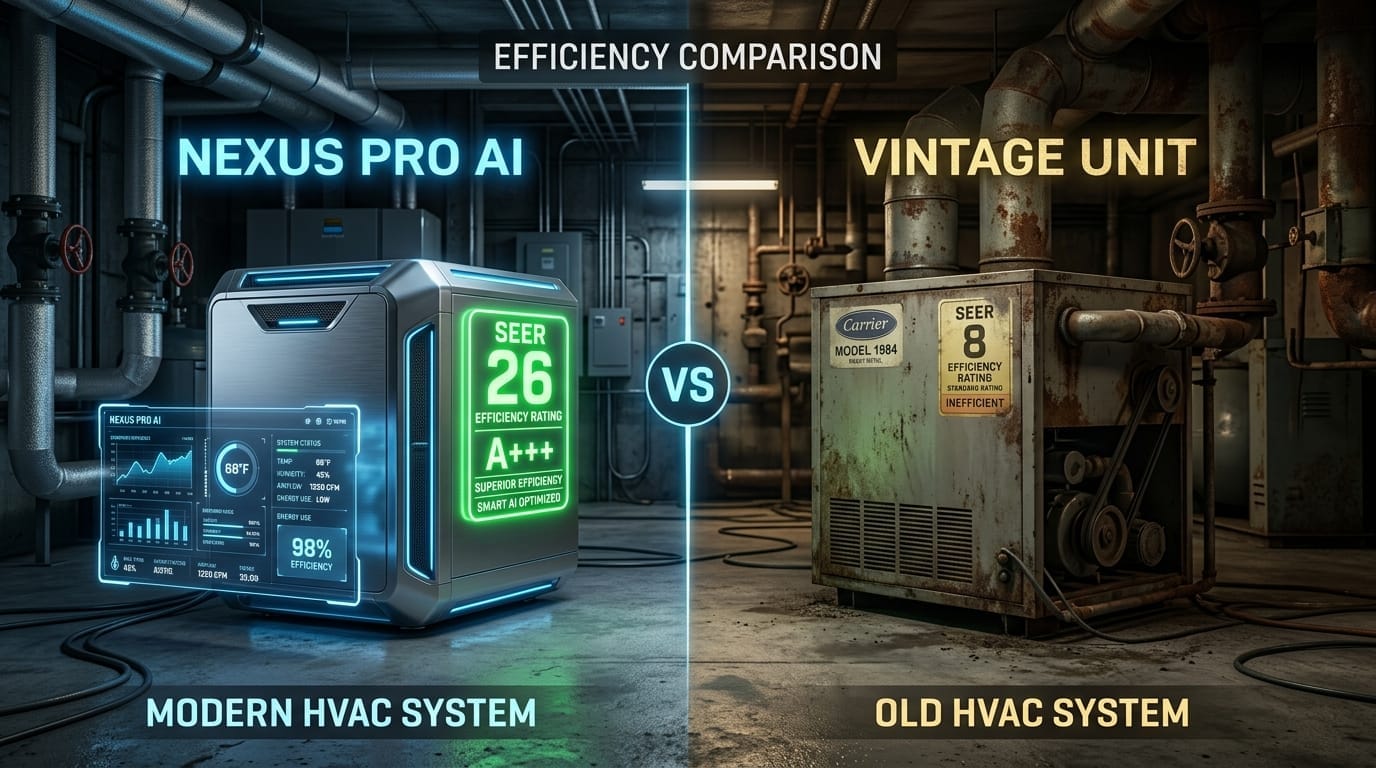
Here's the uncomfortable truth most contractors won't tell you: in many situations, premium efficiency is a terrible investment. I've seen homeowners in mild climates spend $5,000 extra on 98% AFUE furnaces that will never earn back that money.
The most common scenario: warm-climate homeowners with short heating seasons. A Houston homeowner might run their furnace 60-80 days per year. The difference in annual gas cost between an 80% and 95% AFUE furnace might be $60-80. At that rate, a $2,500 premium takes 30+ years to pay back—longer than the equipment's lifespan.
Second scenario: people replacing relatively recent, decent-efficiency equipment. If you're swapping out a 15-year-old 88% AFUE furnace for a 95% unit, you're only gaining 7 percentage points of efficiency. The savings are much smaller than replacing a 1970s 65% unit. Your payback stretches out dramatically.
Third scenario: short-term homeowners. If you're planning to sell in 5-7 years, premium efficiency rarely makes sense. The next owner may not value it, and you won't be around to collect the savings. I've seen this play out repeatedly—people who could have put that $4,000 into kitchen updates instead spent it on efficiency they never recouped.
Want to calculate the exact savings percentage for your situation? Use our energy savings percentage calculator to compare old vs new equipment costs.
What Most Homeowners Get Wrong: Choosing the most efficient option "because it saves money" without calculating payback. Salespeople love efficiency upgrades because they carry high margins. Always ask: "What's the annual savings, and how long does it take to earn back the extra cost?" If they can't answer, walk away.
The Heat Pump Question: Hype vs Reality
Heat pumps have become the go-to recommendation for HVAC upgrades, and they've genuinely gotten better. Modern cold-climate heat pumps work down to -15°F and even below in some cases. But are they right for everyone? Absolutely not.
The heat pump advantage is clearest in moderate climates—zones 6 through 8 (think Virginia, Tennessee, parts of Texas and California). In these areas, heat pumps can handle most of the heating load at a fraction of the cost of electric resistance or even gas furnaces in some cases. I've seen Austin homeowners cut their winter heating costs in half by switching from electric resistance to a heat pump.
In truly cold climates—Minnesota, Montana, northern Ontario—heat pumps become problematic. At temperatures below about -10°F, even the best cold-climate heat pumps lose efficiency dramatically. You either need backup electric resistance heat (which is expensive to run) or a dual-fuel setup with a gas furnace. The complexity and cost increase, and the savings shrink versus just using the gas furnace.
For cooling-dominant climates—Phoenix, Las Vegas, south Florida—heat pumps are excellent. They provide efficient cooling in summer and modest heating in winter. The math here is usually favorable, since AC runs 5-7 months while heating might be 1-2 months.
ENERGY STAR heat pumps start at 15 SEER cooling efficiency, with advanced models reaching 22+ SEER. The cooling savings alone can justify the investment in hot climates. But the same logic that applies to furnaces applies here: the efficiency premium must pay back within your expected timeframe.
The Efficiency Decision Matrix
Here's the framework I use with clients to determine the right efficiency level. Answer these questions and the decision becomes clearer:
Question 1: How long will you stay?
Less than 7 years: Stick to standard or mid-efficiency. The next buyer won't pay for your premium upgrades.
7-15 years: Mid to high-efficiency usually makes sense.
15+ years: Premium efficiency might pay off if other conditions align.
Question 2: What's your heating load?
Under 500 therms/year (warm climate): Standard efficiency. Premium is rarely worth it.
500-1000 therms/year: Mid-efficiency sweet spot.
Over 1000 therms/year (cold climate): High-efficiency often makes sense.
Question 3: What are you replacing?
20+ year old equipment: Bigger efficiency jump = faster payback.
10-15 year old equipment: Smaller jump = check the numbers carefully.
Relatively new equipment: Probably not time to upgrade at all.
Question 4: Local energy costs?
High gas prices (> $1.30/therm): Efficiency pays back faster.
Low gas prices (< $0.90/therm): Efficiency takes longer to pay back.
Expert Insight: Use simple payback to decide: (Extra cost) ÷ (Annual savings) = Years to break even. If it's longer than your planned stay in the home, don't do it. If it's under 10 years and you're staying put, it's usually worth considering. Anything in between requires careful evaluation.
Real HVAC Efficiency Comparisons
Based on my field data from clients across North America, here's what different efficiency upgrades actually deliver in real savings:
| Upgrade Scenario | Premium Cost | Annual Savings | Payback (Cold) | Payback (Warm) | Worth It? |
|---|---|---|---|---|---|
| Furnace 80% → 90% AFUE | $1,200-1,800 | $120-180 | 8-12 years | 20+ years | Cold only |
| Furnace 80% → 95% AFUE | $2,000-2,800 | $180-240 | 10-14 years | 30+ years | Rarely warm |
| AC SEER 14 → 16 | $600-1,000 | $80-120 | 8-12 years | 6-8 years | Usually |
| AC SEER 16 → 20 | $1,200-1,800 | $60-80 | 18-25 years | 15-20 years | Maybe |
| Standard → Heat Pump | $3,500-6,000 | $300-500 | 10-15 years | 7-10 years | Usually warm |
*Cold = Minnesota/Ontario climate, Warm = Texas/Florida. Actual results vary by usage.
The pattern is clear: efficiency upgrades make the most sense for cooling (since everyone uses AC in hot climates) and for heating in cold climates. The worst ROI is premium heating efficiency in warm climates where you barely need to heat at all.
Efficiency Upgrade Questions Answered
Possibly. Not always—sometimes the premium model makes sense. But if you're in Atlanta and running the heater 90 days a year, a 98% AFUE furnace over a 92% model might take 18 years to pay back the difference. Your contractor might genuinely believe it, or he makes more margin on the higher-end units. Either way, ask for the payback calculation in writing.
Depends where you live. In Phoenix, running AC six months a year, SEER 22 over SEER 16 might save $40/month. In Seattle, where you barely run the system two months a year, that same premium might save $8/month. Payback: 15 years versus 4 years. If you're staying in your home forever, maybe. If you might move in 10 years, probably not.
He might be telling the truth, but his situation isn't yours. His Minnesota winters versus your North Carolina mild climate? Different fuel costs, different usage patterns, different upgrade scenario. Maybe he was replacing a 1970s 65% AFUE dinosaur. You're replacing a 15-year-old 88% unit. The same upgrade math doesn't apply.
They've gotten genuinely good. Cold-climate heat pumps work fine down to -15°F now, and they're incredible in moderate climates. But in Montana winters at -20°F, even the best ones struggle and you need backup heat anyway. The sweet spot is zones 6-8—somewhere the temperature rarely plummets but you still have meaningful heating needs.
Not always. Efficiency improvements have diminishing returns. The jump from SEER 14 to 16 is typically worth it. The jump from 20 to 22 is often not. Same with furnaces—the jump from 80% to 90% AFUE usually pays back. The jump from 95% to 98% rarely does, unless you're in a very cold climate with very high gas prices.