Table of Contents
The AC Cost Formula You Can Use Today
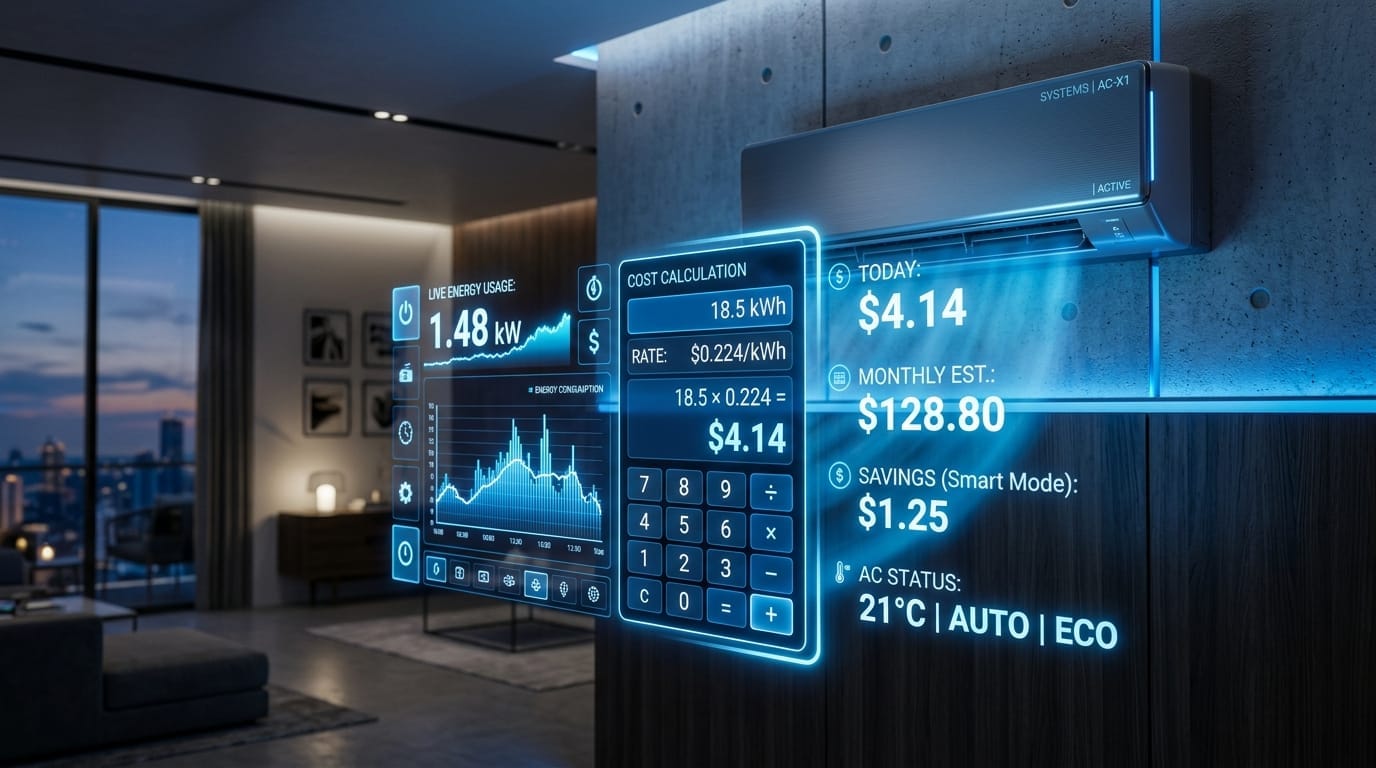
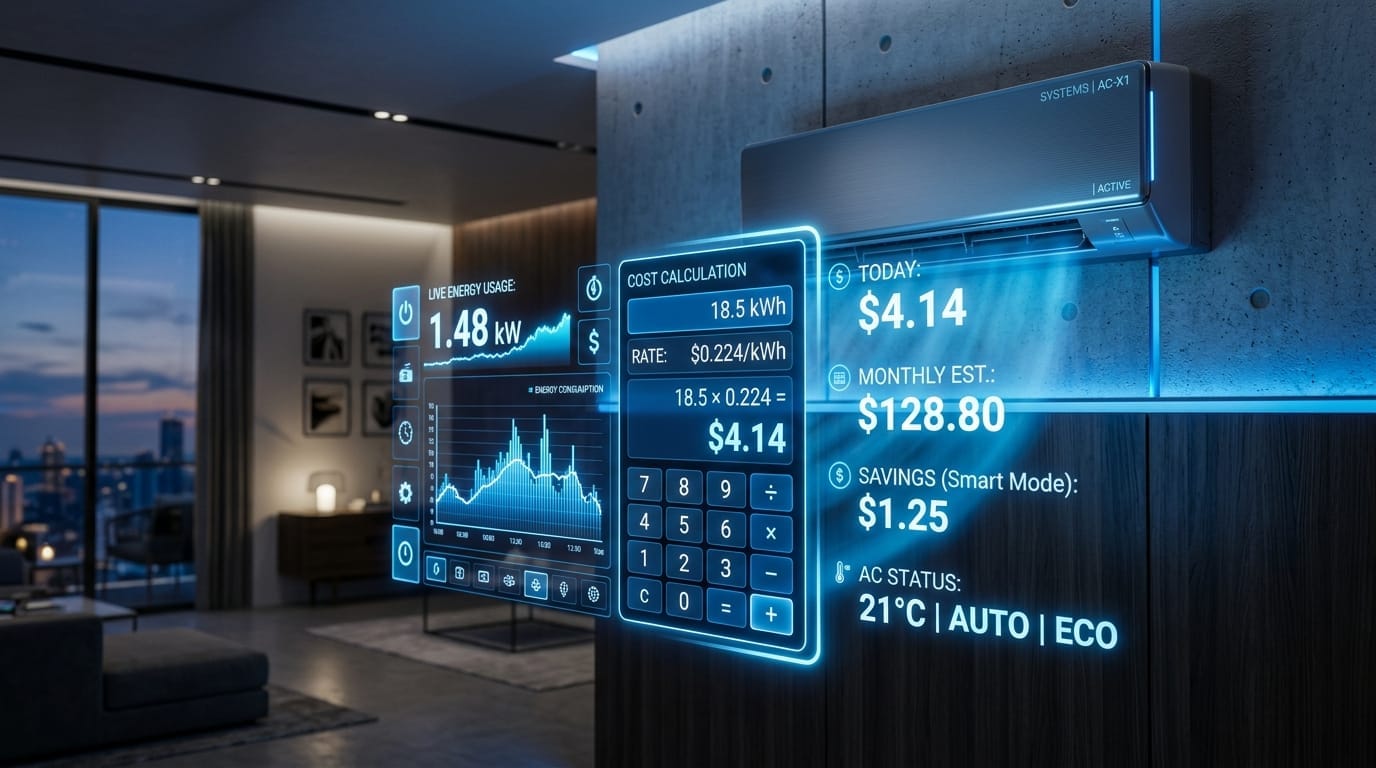
Before I explain the numbers, let me give you the actual formula I use in every home assessment. The calculation is straightforward:
Cost = (Watts × Hours ÷ 1,000) × Electricity Rate
That's it. But here's where most people get stuck — they don't know their AC wattage, and electricity rates vary wildly across the USA and Canada. According to the U.S. Department of Energy, residential cooling accounts for about 12% of home energy use nationwide, but in hot climates like Texas or Florida, that number can exceed 25%.
To find your AC wattage, you have two paths. First, check the nameplate label on your outdoor condenser unit — it shows rated input in watts or amps. Second, calculate it mathematically: divide your AC's BTU rating by its SEER efficiency rating. For example, a 12,000 BTU (1-ton) unit with SEER 16 rating uses exactly 750 watts: 12,000 ÷ 16 = 750W. Use this AC running cost calculator to estimate your specific costs.
One ton of cooling equals 12,000 BTU, which is the baseline unit for residential air conditioning. A typical 2,000 sq ft home in a moderate climate needs a 3-ton (36,000 BTU) system, while a larger home in hot climates might require 4-5 tons. The key variable is your SEER rating — ENERGY STAR certified units start at SEER 15, but older systems often run at SEER 10 or below, consuming 50% more electricity for the same cooling output.
Three Real Scenarios from My 2025 Audits
Scenario 1: Houston Bedroom (Window Unit)
A client in Houston's Meyerland neighborhood asked me to calculate cooling costs for her 14×16 bedroom. She runs a 10,000 BTU window AC (EER 10 = 1,000W) from 10pm to 6am nightly — 8 hours during peak summer rates.
At Houston's average electricity rate of $0.128/kWh: (1,000W × 8 hours ÷ 1,000) × $0.128 = 8 kWh × $0.128 = $1.02 per night
Over a 30-day month, that's $30.60. But here's what surprised her — her actual bill showed $48. The gap came from the AC cycling on and off, running closer to 10 hours equivalent due to her thermostat setting of 70°F in a humid room. A thermostat savings calculator can help you estimate potential savings from adjusting your settings.
Scenario 2: Dallas Colonial (Central AC)
In July 2025, I evaluated a 2,400 sq ft home in Dallas with a 3-ton SEER 14 central AC. The homeowner worked from home and kept the thermostat at 72°F from 7am to 10pm daily.
Calculation: 36,000 BTU ÷ 14 SEER = 2,571 watts. Running 12 hours/day: (2,571 × 12 ÷ 1,000) × $0.14 = 30.85 kWh × $0.14 = $4.32 per day
Monthly cost at 30 days: $129.60 for cooling alone. Add the 15% energy loss from ductwork in the unconditioned attic, and her actual August bill hit $148. Natural Resources Canada estimates that duct leakage can reduce system efficiency by 20-30%.
Scenario 3: Phoenix Mini-Split (Modern Efficiency)
A retiree in Phoenix's Sun City installed a 4-zone mini-split system with a combined 42,000 BTU capacity and SEER 22 rating. He runs it from 2pm to 10pm daily — 8 hours during the worst heat.
Calculation: 42,000 BTU ÷ 22 SEER = 1,909 watts. At Phoenix's $0.14/kWh: (1,909 × 8 ÷ 1,000) × $0.14 = 15.27 kWh × $0.14 = $2.14 per day
Monthly cost: $64.20 for his entire 2,200 sq ft home. The mini-split's inverter technology adjusts compressor speed to match cooling demand, reducing average consumption by 25-30% compared to conventional systems. Learn more about average electricity usage for different AC types in our comprehensive guide.
Money Saver: If you're comparing central AC vs mini-split, don't just look at the upfront cost. The SEER advantage of mini-splits (typically 18-25) versus central systems (14-16) means 30-40% lower operating costs over a 15-year equipment life. Use our HVAC sizing calculator to determine what system size you actually need for your home. In hot climates, the energy savings often exceed the installation cost difference within 5-7 years.
When the Calculator Revealed a Problem
In August 2025, a homeowner in Tampa, Florida showed me his electric bill: $312 for the month. His home was 1,900 sq ft with a 3-ton SEER 14 central AC. He ran it at 72°F around the clock. Tampa's average August high is 91°F, suggesting roughly 8-10 hours of daily AC runtime.
Using the calculator: 3-ton SEER 14 = 36,000 ÷ 14 = 2,571W. Running 10 hours/day for 31 days at $0.13/kWh:
(2,571 × 10 × 31 ÷ 1,000) × $0.13 = 797 kWh × $0.13 = $103.61 calculated
But his bill showed $312. The calculator predicted $104 for AC alone. That's a $208 gap — nearly 3x the expected cost.
Three issues explained the difference. First, the home's ductwork in the unconditioned attic had 28% air leakage (measured with a duct blaster test). Second, the attic had only R-11 insulation — the heat gain through the ceiling forced the AC to run 14-16 hours/day instead of the estimated 10. Third, the 72°F thermostat setting added approximately 12% more runtime compared to the DOE-recommended 74-76°F for Florida homes. Combined, these factors pushed actual AC consumption to approximately 1,920 kWh — nearly 2.4x the calculated estimate.
After duct sealing ($850), adding attic insulation to R-38 ($1,400), and raising the thermostat to 75°F, the following August's bill dropped to $178 — a 43% reduction. See how insulation upgrades can reduce your cooling costs significantly.
🔍 Key Insight: If your actual AC bill is more than 30% higher than the calculator predicts, something is wrong. Common culprits: duct leakage (15-30% of cooled air lost), inadequate attic insulation, dirty evaporator coil or condenser, refrigerant undercharge, or thermostat set too low. A professional energy audit identifies which factor is driving the excess consumption.
Quick Reference: Monthly AC Cost at a Glance
This table shows estimated monthly AC cost for common system types at three electricity rates, assuming 8 hours of daily runtime during peak summer:
| System | Wattage | Monthly kWh | at $0.12/kWh | at $0.16/kWh | at $0.24/kWh |
|---|---|---|---|---|---|
| Window 5,000 BTU | 500W | 120 | $14.40 | $19.20 | $28.80 |
| Window 10,000 BTU | 1,000W | 240 | $28.80 | $38.40 | $57.60 |
| Mini-Split 12K BTU | 600W | 144 | $17.28 | $23.04 | $34.56 |
| Central 2-ton SEER 16 | 1,500W | 360 | $43.20 | $57.60 | $86.40 |
| Central 3-ton SEER 16 | 2,250W | 540 | $64.80 | $86.40 | $129.60 |
| Central 4-ton SEER 14 | 3,430W | 823 | $98.76 | $131.68 | $197.52 |
| Central 5-ton SEER 14 | 4,285W | 1,028 | $123.36 | $164.48 | $246.72 |
These are AC-only costs. Your total electric bill will include lighting, appliances, water heater, and other loads.
AC Running Cost Questions Answered
Check the nameplate label on the unit — it lists rated input in watts, amps, and voltage. For central AC, the label is on the outdoor condenser. For window units, it's on the back or side. If the label is illegible, calculate wattage by dividing the BTU rating by the SEER (or EER for window units).
The calculator assumes the AC runs at its rated wattage. In reality, dirty coils, low refrigerant, duct leaks, poor insulation, and extreme outdoor heat all increase actual consumption. If your bill exceeds the calculation by more than 30%, get a professional audit to identify the cause.
Yes. A heat pump in cooling mode operates identically to an AC — the formula is the same. Use the heat pump's SEER rating and BTU capacity to calculate wattage. Most heat pumps have SEER ratings of 15-22.
Check your utility bill for the line item showing price per kWh. If your bill has tiered pricing (different rates at different usage levels), use the blended rate — divide your total energy charge by your total kWh consumption for the month.
Yes. Inverter (variable-speed) compressors adjust their speed to match cooling demand rather than cycling on and off. This reduces average wattage by 15-30% compared to single-stage units of the same capacity, especially during moderate outdoor temperatures when the compressor runs at partial load.
Related Blog Posts

How Insulation Reduces Heating and Cooling Cost
How R-value and air sealing pay for themselves.
Read →
Average Heating Cost Per Month in USA
Real costs by fuel type, home size, and climate zone with actual numbers.
Read →
Best Temperature Settings to Save Cooling Cost
The right thermostat setting saves $50-$150 per summer.
Read →